Selecting, trimming, and reordering slices: log lines, pod names, metric labels. Four attempts, escalating; the prose exists to explain what you just got wrong.
pods := []string{"web-1"}
append(pods, "web-2")
fmt.Println(pods)
[web-1]
Wrong is fine — you'll hit exactly this in the worked example below.
"Make the zero value useful." — Go Proverb
A slice is a view over an array: pointer, length, capacity. Think of it like a window over a bookshelf — the pointer says which shelf, the length says how many books are visible through the window, and the capacity says how many the shelf can hold before you need a bigger one. What you need to drill is using slices without thinking.
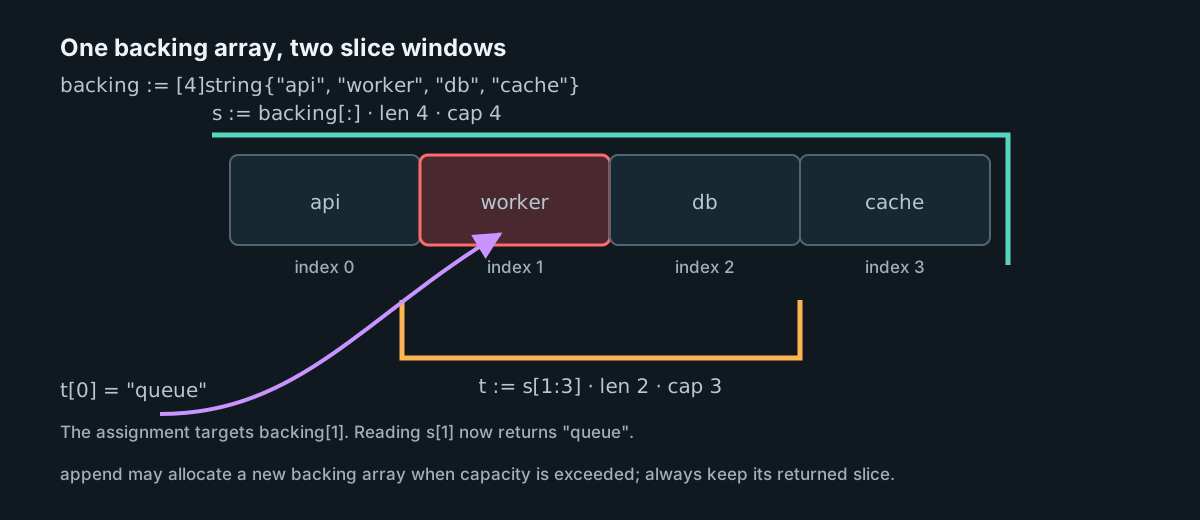
t := s[1:3] and t[0] = "queue", what does s[1] contain? Both slices still point into the same backing array.fruits := []string{"apple", "banana", "cherry", "date", "elderberry"}
// Access by index
fruits[0] // "apple"
fruits[len(fruits)-1] // "elderberry" (last element)
// Slice expression — [start : end)
// start is inclusive, end is exclusive
fruits[1:3] // ["banana", "cherry"]
// Omit start → from the beginning
fruits[:3] // ["apple", "banana", "cherry"]
// Omit end → through the end
fruits[2:] // ["cherry", "date", "elderberry"]
// Last N elements
fruits[len(fruits)-2:] // ["date", "elderberry"]
# Python: s[-1] gets last element
# Go: no negative indexing. Use s[len(s)-1]

# Python: s[1:3] — same semantics
# Go: s[1:3] — identical behavior
Gotcha: Accessing
s[len(s)]panics with "index out of range." Off-by-one errors are the #1 slice bug. When in doubt, printlen(s)first.
Append & Grow
That pretest was the single most common slice bug in Go: append doesn't modify the original — it returns a new slice. If you throw away the return value, you throw away the data. The fix is one character:
pods = append(pods, "web-2") // reassign!
Now the correct patterns:
var pods []string            // nil slice, length 0
pods = append(pods, "web-1") // [web-1]

// Append multiple at once
pods = append(pods, "web-2", "web-3")
// pods = [web-1, web-2, web-3]

// Append another slice (... unpacks it)
more := []string{"db-1", "db-2"}
pods = append(pods, more...)
// pods = [web-1, web-2, web-3, db-1, db-2]
Key insight:
appendmay return a new underlying array if capacity is exceeded. Always reassign:s = append(s, item). The compiler won't warn you if you forget — the code runs fine and silently loses data.
Building a slice in a loop:
// Build "step-1" through "step-4"
var steps []string
for i := 1; i <= 4; i++ {
    steps = append(steps, fmt.Sprintf("step-%d", i))
}
fmt.Printf("len=%d cap=%d %v\n", len(steps), cap(steps), steps)
// len=4 cap=4 [step-1 step-2 step-3 step-4]
// (cap may vary — Go doubles capacity as needed)
Pre-allocation with make
When you know the size upfront, pre-allocate. When your monitoring tool processes 50,000 metrics per scrape, the difference between "grow the backing array 17 times" and "one allocation" is the difference between a smooth scrape and a GC pause that trips your own alerts.
Each time len exceeds cap, Go reallocates a bigger backing array. The growth strategy isn't fixed — for small slices it roughly doubles, for larger ones it grows ~25%. The exact numbers don't matter; what matters is that pre-allocating with the right cap upfront skips all the copying.
// Bad: grows the backing array multiple times
var results []string
for _, name := range names {
    results = append(results, name)
}

// Good: one allocation
results := make([]string, 0, len(names))  // length 0, capacity len(names)
for _, name := range names {
    results = append(results, name)
}

// Also good: make with length, then assign by index
results := make([]string, len(names))  // length AND capacity = len(names)
for i, name := range names {
    results[i] = name
}
make([]string, 0, 5) = length 0, capacity 5 (append to fill). make([]string, 5) = length 5, capacity 5 (assign by index).
# Python: results = [name for name in names]  — list comprehension
# Go: no comprehensions. Loop and append. Pre-allocate with make().
Batching (Processing in Chunks)
You have 10 items and need to process them in batches of 4. That means groups: [0:4], [4:8], [8:10]. How do you loop that?
Start from what you know — a C-style loop counts up by 1:
for i := 0; i < len(items); i++ { ... }
//  i goes: 0, 1, 2, ..., 9
But you don't want every index — you want the start of each batch. Those are 0, 4, 8. The step isn't 1, it's batchSize. The post part of a C-style loop can be anything, so change i++ to i += batchSize:
for i := 0; i < len(items); i += batchSize { ... }
//  i goes: 0, 4, 8
Now each i is the start of a batch. The end is i + batchSize. So the batch is items[i : i+batchSize] — except there's a problem. When i=8 and batchSize=4, i+batchSize=12, which is past the end of a 10-element slice. Go will panic with "index out of range."
The fix: cap the end index so it never exceeds len(items):
end := i + batchSize
if end > len(items) {
    end = len(items)
}
// Now items[i:end] is always safe
That's the whole pattern. You derive it from three ideas: (1) C-style loops can step by any amount, (2) each step is the start of a batch, and (3) the last batch might be short so you clamp the end.
Finding Min / Max
Go has no min()/max() for slices. You build it from a loop. The question is: what do you initialize min and max to? If you start with min := 0, you'll get 0 as the minimum for any slice of positive numbers — that's wrong. If you start with min := 999999, you're guessing at an upper bound — also wrong. The safe answer: initialize both to the first element, then scan the rest.
min, max := ,    // not 0 — why?

// skip the element you already used
for _, p := range  {
    if p < min {
        min = p
    }
    if p > max {
        max = p
    }
}
One pass, two comparisons per element. The loop starts one element in, because the initialization already covered it. This works for any comparable type — ints, floats, strings.